26.10.2026 Report on CanCham’s Canadian Thanksgiving Dinner 2026
26.10.2026
| |
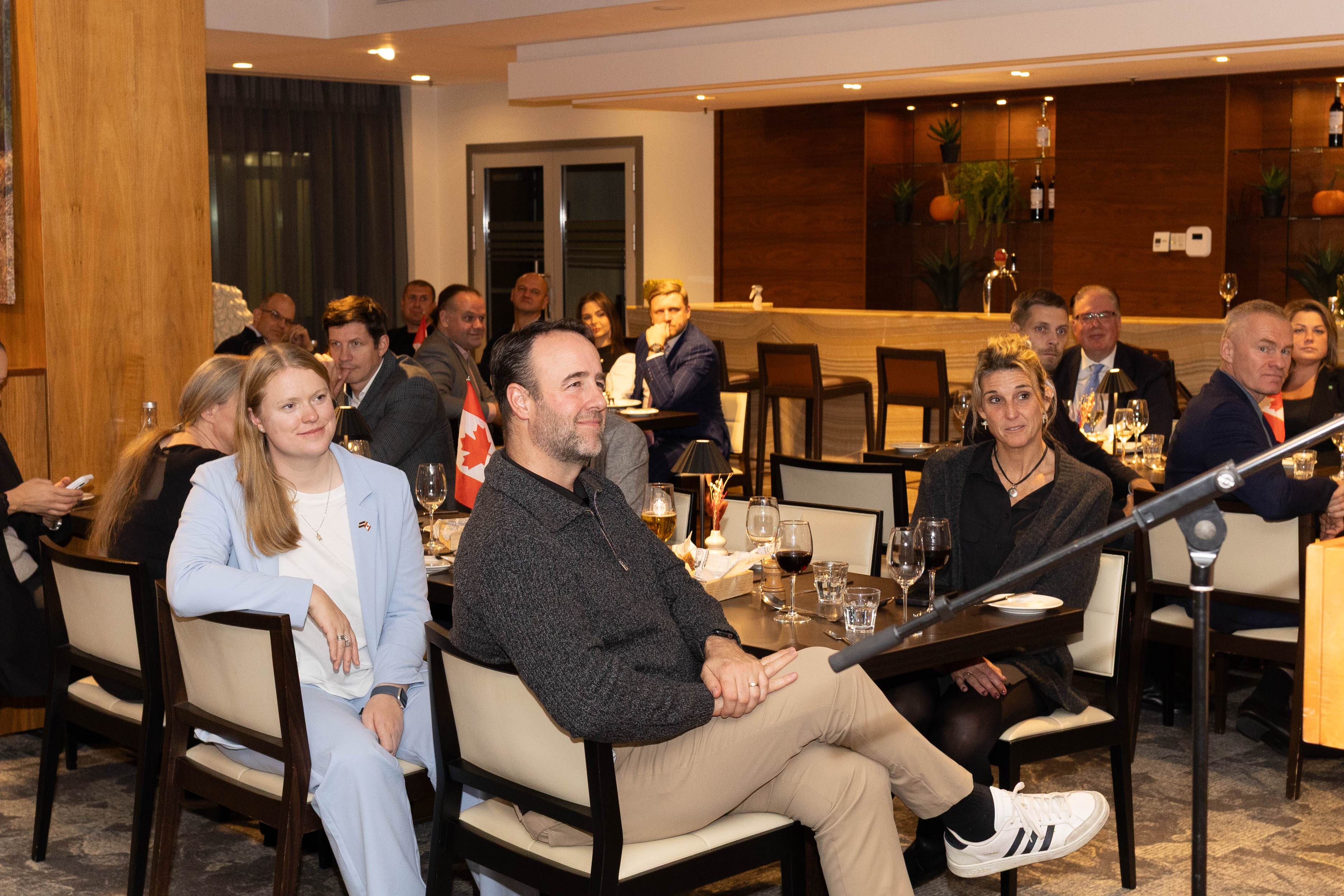
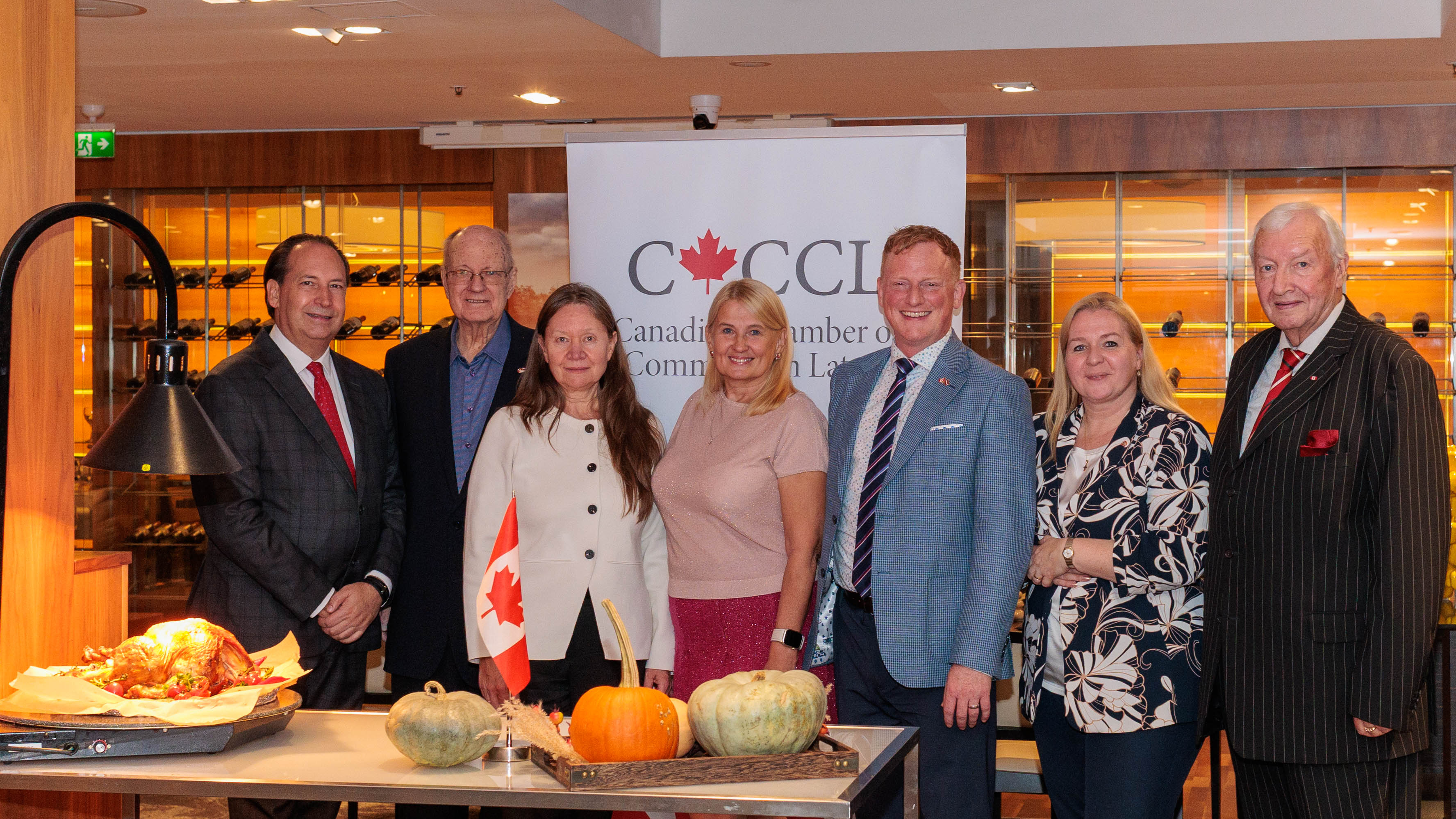
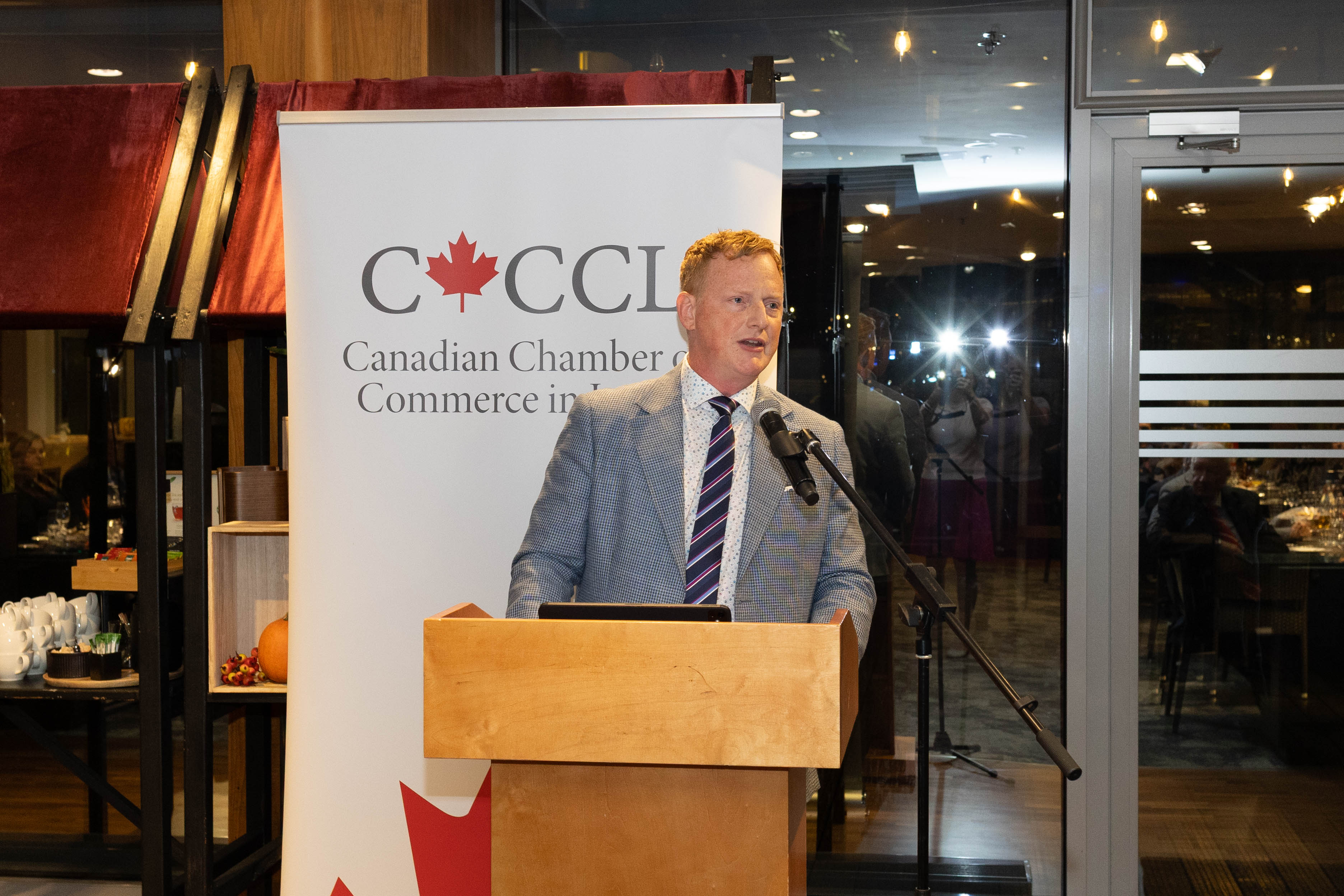
The evening began with a welcome drink and an opportunity for informal networking. CanCham Chairman Ed Kalvins welcomed the guests, and the special guest speaker was H.E. Timothy Edwards, Canada’s Ambassador to Latvia. The dinner featured a traditional three-course Thanksgiving menu, including roast turkey with stuffing, potatoes, vegetables and cranberry sauce—a familiar taste of Canada in Riga.
The Ambassador outlined two principal priorities: supporting Canada’s defence and security commitment to Latvia, including Operation REASSURANCE, and translating that strong security relationship into deeper commercial cooperation. He identified defence-industrial cooperation, clean technologies and energy, information and communications technologies—including artificial intelligence—and academic and research partnerships as particularly promising areas. He also highlighted Canada’s wider objective of diversifying its international trade, including the ambition to double non-U.S. exports by 2035. Among the initiatives discussed were Canada’s new Strategic Exports Office, Canadian participation in the European Union’s SAFE defence-financing initiative, and plans for a Defence, Security and Resilience Bank, with a regional office envisaged in Riga. He noted the opportunities for closer Canada–EU cooperation and recalled Latvia’s distinction as the first EU member state to ratify CETA. Closing on a personal note, Ambassador Edwards spoke about the meaning of Thanksgiving to his family: an occasion to reflect on life’s experiences and express gratitude for the people who enrich our lives. He thanked CanCham members for their partnership and expressed the hope that the economic and commercial relationship between Canada and Latvia would grow to match the strength of their political, security and personal ties. CanCham’s Thanksgiving Dinner is about more than a traditional meal. It brings Canadians and Latvians together in an informal setting, helps build personal relationships and supports the Chamber’s objective of strengthening the bonds between our two countries. We thank Ambassador Edwards for his thoughtful and encouraging address, our members and guests for joining us, and the Radisson Blu Elizabete Hotel team for hosting the occasion. For upcoming CanCham activities, including the TFL Procurement Seminar & Luncheon on November 2nd, 2026, please visit https://cancham.lv/.
| |
Ambassador Timothy Edwards — Address as Delivered to the Canadian Chamber of Commerce Thanksgiving Dinner | October 12, 2026 | Radisson Blu Elizabete Hotel, Riga
I have already had the pleasure of meeting your President, Ed Kalviņš, and Vice-President, Una Brūna, and have been briefed on the Chamber's growing ambitions and expanding activities, including your Strategic Partnership Initiative. I was particularly pleased to learn about this work, which complements so effectively the efforts of Canada's Trade Commissioner Service and our Embassy team here in Latvia. The Canadian Chamber has been an invaluable ally and force multiplier in each of my previous postings abroad. I have been looking forward to this event since my arrival and am eager to build on that tradition of partnership over the next four years. The success of Canada's economic engagement abroad depends not only on governments, but on business leaders, entrepreneurs, innovators, and professional associations such as yours that help connect people, ideas, and opportunities across borders. It is customary at public events in Canada to begin with a land acknowledgement recognizing the historical stewardship of Indigenous peoples in the city or province where we gather. Here in the eastern Baltics, the history of human settlement is, of course, very different from that of Canada. And so, while honouring the enduring contributions of First Nations, Inuit, and Métis peoples to the Canada we know today, I would also like to acknowledge and celebrate the deep roots of the Latvian people and their longstanding relationship with, and attachment to, the land on which we assemble this evening. Before getting down to business, I thought I would briefly introduce myself, as this is the first time I am meeting many of you. I am a career diplomat with Global Affairs Canada and have spent the better part of the past twenty-three years working on international security issues, particularly the non-proliferation and disarmament of weapons of mass destruction. Geographically, I have focused on the regions of East and Southeast Asia. While Ottawa is my hometown, I grew up in a Foreign Service family myself and spent portions of my youth in Geneva, Seoul, and Tokyo. Latvia is my fourth diplomatic posting abroad, following assignments in Hong Kong, The Hague, and most recently Vientiane, where I served as Head of Office for Laos. You may reasonably wonder how someone with that background ended up here in Latvia. The answer is straightforward. As a lifelong security specialist, I wanted to serve on the front line of what I believe is the defining security challenge of our generation: the effort of an aggressive and authoritarian Russia to challenge the foundations of European security and to rewrite, through force, both history and borders. This region is therefore of profound strategic consequence to Canada. One need only look at Op REASSURANCE, Canada's largest military deployment abroad, to understand the importance Ottawa places on the security of Latvia and NATO's Eastern Flank. At this stage of my career, I can think of nowhere I would rather serve. Which naturally raises the question: now that I’m here, what priorities have I been sent by Ottawa to advance? The first thing to say is that those priorities remain fundamentally unchanged from those of my predecessor, Brian Szwarc. My principal objective is to advance Canada's defence and security interests in Latvia, notably by supporting Op REASSURANCE and ensuring an open and productive relationship with our Latvian hosts. Many of you will be aware that, at the NATO Summit in Ankara this past July, Prime Minister Carney reaffirmed Canada's long-term commitment to Latvia and the Alliance's collective defence. Among the key announcements were:
My second major objective in Latvia follows directly from the first. Canada's substantial defence commitment in this region creates opportunities to strengthen our relationship in trade, investment, innovation, and research collaboration. One of my top priorities is therefore to help translate Canada's robust political and security presence into deeper economic and commercial partnerships. As you may be aware from our embassy’s Senior Trade Commissioner Nicolas Lepage, our immediate focus includes (1) the defence sector and defence-industrial cooperation; (2) clean technologies and the energy transition; (3) information and communications technologies, including artificial intelligence; and finally (4) academic and research partnerships. These are sectors where Canada and Latvia possess complementary strengths and shared strategic interests. These objectives align directly with a central priority of the Government of Canada: diversifying our trade and economic partnerships. As the international trading system undergoes its most significant transformation in decades, Canada is working to strengthen its long-term prosperity by broadening its economic relationships and reducing vulnerability to external shocks. Trade accounts for roughly two-thirds of Canada's GDP. Maintaining and expanding access to global markets is therefore not simply an economic objective; it is fundamental to our future prosperity and resilience. To meet this challenge, Canada has established an ambitious objective: doubling Canada's non-US exports by 2035. In practical terms, this means increasing overseas trade from approximately $300 billion to $600 billion over the next decade. Officials estimate that roughly two-thirds of that growth may come through the natural expansion of existing commercial relationships. The remaining growth, however, will require active government support and strategic intervention. Accordingly, this diversification agenda has become a whole-of-government effort. It includes generational investments in trade-enabling infrastructure at home—from ports, railways, roads, and airports to energy systems, critical mineral projects, and major logistics corridors. It also includes expanding market access through new and enhanced trade agreements, while continuing to leverage established institutions such as the WTO, G7, G20, and OECD. These forums will remain important tools for building the flexible coalitions required to strengthen Canada's prosperity and resilience in a complex world. I would like to highlight several new instruments that are being developed to support this trade diversification agenda, particularly in Europe. The first is Canada's new Strategic Exports Office. Originally announced in Budget 2025 and recently established within Global Affairs Canada, the Strategic Exports Office is designed to improve Canada's ability to compete for major international commercial contracts. Its mandate is to align diplomatic engagement, financing tools, government advocacy, and commercial expertise behind projects of strategic importance to Canada's economy and industrial base. The office will focus on sectors where Canada possesses, or can develop, a strong global competitive advantage, including defence and aerospace, infrastructure, energy and energy transition technologies, critical minerals, digital ecosystems, and financial services. Europe, the Gulf, and the Indo-Pacific will be among its priority regions. The second tool is the European Union's Security Action for Europe, or SAFE, initiative. Following formal EU approval in June, Canada has become the first non-European participant in SAFE, a landmark achievement that reflects the growing convergence of Canadian and European security interests. Canadian companies are now eligible to participate in procurement opportunities supported by SAFE's €150-billion financing mechanism. Importantly, the agreement permits up to 80% Canadian content in eligible procurements, creating significant opportunities for Canadian firms while strengthening their integration into European defence supply chains. The third, and perhaps most innovative, tool is the nascent Defence, Security and Resilience Bank, or DSRB. The DSRB is envisioned as a multilateral financial institution dedicated to making defence and security financing more affordable and accessible. Its objectives would include:
Canada, Latvia, and seven like-minded partners agreed upon the Bank’s founding Articles of Agreement in Montréal in April 2026 and jointly committed to establishing the institution, with Canada serving as host country. Under current plans, a regional DSRB office would be established here in Riga. While the Bank remains under development and is expected to become operational in early 2027, it already demonstrates the degree to which defence, security, economic resilience, and industrial policy are becoming interconnected. Taken together, these initiatives—the Strategic Exports Office, SAFE, and DSRB—hold considerable promise for deepening commercial ties between Canada and the Baltic region. Yet anyone who has followed recent developments in Europe knows that this may only be the beginning. This month marks the tenth anniversary of the signing of the Canada-EU Comprehensive Economic and Trade Agreement, or CETA, and next year will mark ten years since its provisional application. The results have been significant. Canada-EU merchandise trade reached C$134 billion in 2025, representing growth of more than 77% compared with pre-CETA levels. Canada has certainly not forgotten that Latvia was the very first EU member state to ratify CETA in February 2017. That early vote of confidence remains deeply appreciated. Today, there is growing political momentum on both sides of the Atlantic to take the Canada-EU relationship to a new level. In her annual State of the Union address to the European Parliament last month, European Commission President Ursula von der Leyen proposed exploring a form of closer association, potentially making Canada the EU's first associate member. In his own speech in Strasbourg the following day, Prime Minister Carney welcomed the idea and expressed openness to deeper cooperation while making clear that Canada is not seeking EU membership per se. Although the concept remains undefined and many details are being negotiated, discussions have highlighted a number of areas where closer association could deliver mutual benefits. These include:
These issues are expected to feature prominently at the upcoming Canada-EU Summit in Montréal on October 29th and 30th. As we await the outcomes of that meeting, I want to assure you that our Embassy will continue working closely with the Canadian Chamber to identify and communicate new opportunities as they emerge. Needless to say, we are approaching a historic moment in Canada's relationship with Europe. From where I stand, it is an exciting time to begin a posting in Latvia. Allow me to close on a more personal note. In introducing myself earlier, I focused on my professional background. But I should also mention that I have arrived in Latvia with my family of four: my wife Amanda, a former broadcast journalist who has already become a very active member of the International Women's Club of Riga, and our two teenage children, Elliott and Rilla, who attend the International School of Riga. Like many Canadian families, we are devoted observers of Thanksgiving. Every year we gather with our extended family for a turkey dinner on the second Sunday of October, just as the maple leaves reach their brilliant crimson peak across eastern Ontario. I was recently asked what Thanksgiving means to us. Beyond a convenient excuse to consume an entirely unreasonable number of calories, it represents an opportunity to reflect on the experiences we have been given and to express gratitude for the people who enrich our lives. In that spirit, I am deeply thankful for the privilege of serving as Canada's Ambassador to Latvia. I am equally grateful for the dedicated partners our Embassy has here in Latvia, including all CanCham members in this room tonight. I look forward to working with you in the years ahead to ensure that the economic and commercial dimensions of the Canada-Latvia relationship grow to match the extraordinary strength of its political, security, and people-to-people foundations. Thank you. Merci. Paldies. |
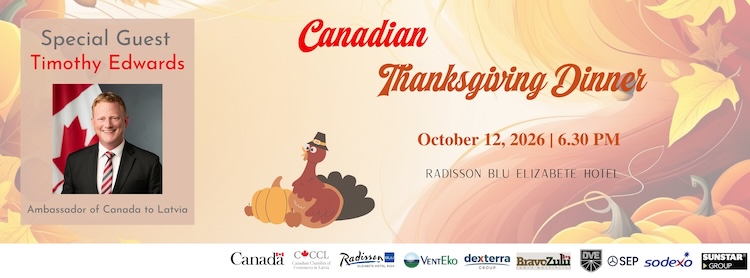
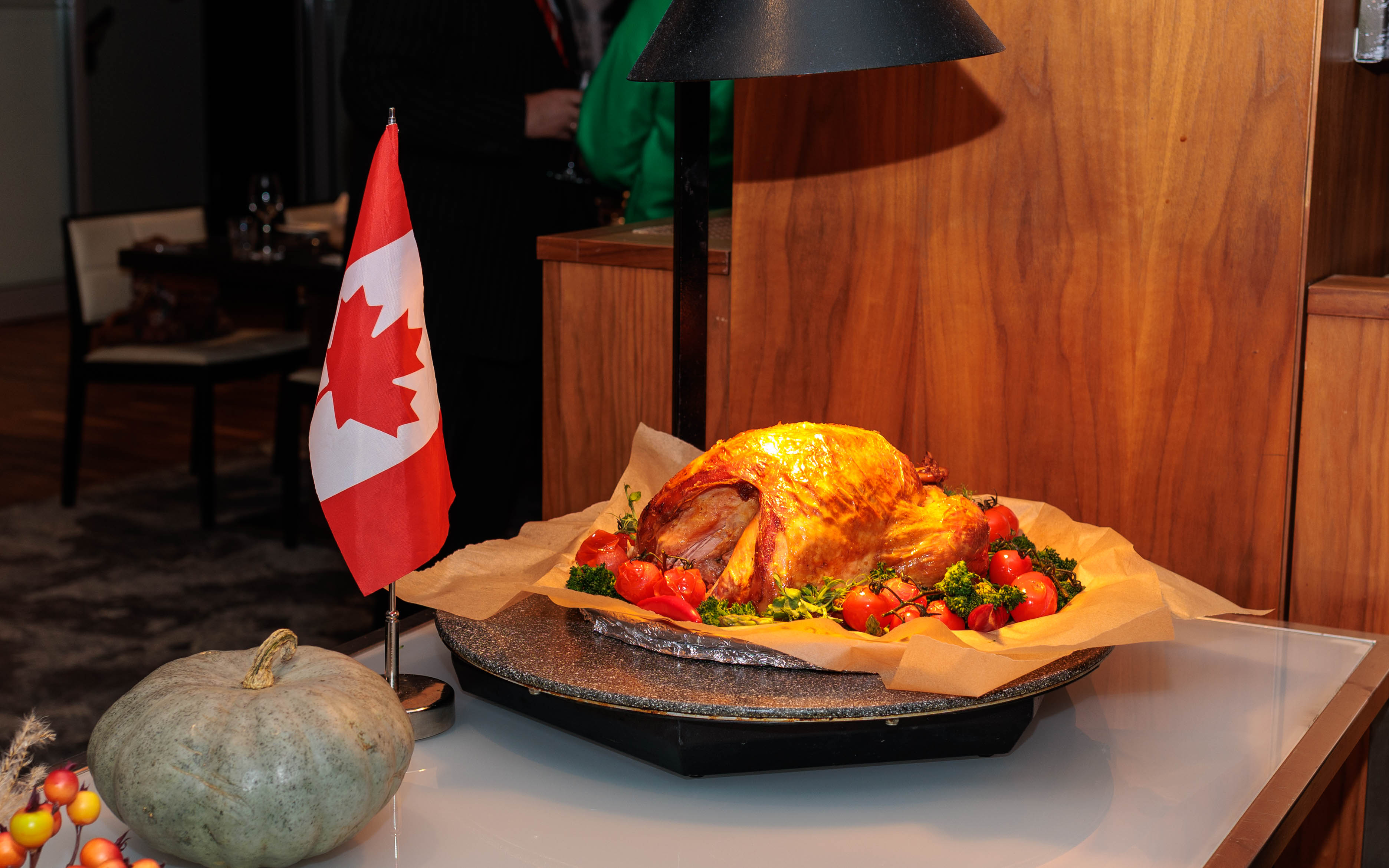 The tradition continues! CanCham members, representatives of the Canadian Embassy, and friends of Canada gathered on Monday, October 12th, 2026 at the Radisson Blu Elizabete Hotel, Elizabetes iela 73, for CanCham’s annual Canadian Thanksgiving Dinner. The evening provided an opportunity to celebrate a much-loved Canadian tradition while renewing friendships and strengthening connections between the Canadian and Latvian communities.
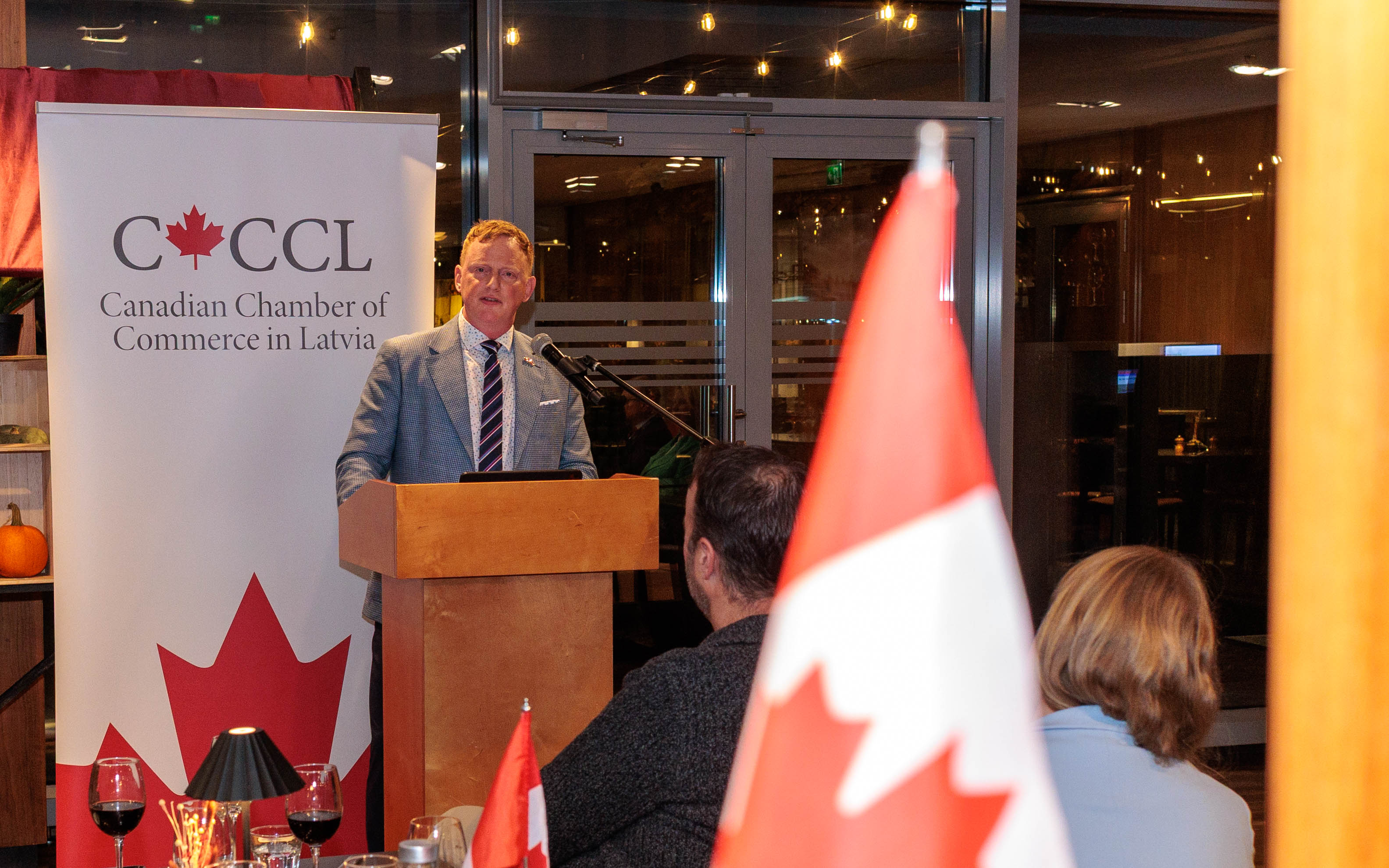 In his address, Ambassador Edwards expressed his appreciation for CanCham’s expanding activities and Strategic Partnership Initiative, which he described as complementing the work of Canada’s Trade Commissioner Service and the Embassy. He emphasized his commitment to working closely with the Chamber during his posting in Latvia and recognized the important role that businesses and professional associations play in building international partnerships.
 Thank you for the warm welcome to Riga.



Back
Upcoming events |
TFL Procurement Seminar/Luncheon.
|
Monday, November 2nd, 2026 from 12.00 to 15.00
|
Gold Level Members |
 |

|
 |

|
 |
 |
Silver Level Members |

|
 |
|

|
 |

|
 |

|
 |

|

|
 |

|

|

|
 |
Significant Partners |

|
 |

|
|

|
|

|
Programs |

|
Website Provider |
|